arXiv:2610.14232 • 🤗 Hugging Face Papers • Speech Event Detector

Speech Event Detector

Timestamped Detection of Non-Verbal Vocalizations and Background Sounds for Rich Speech Transcription

Ayush Kumar Bar
Promila Ghosh
The Boring AI
huggingface.co/spaces/theboringai-work/surround-sound
Interactive Live Demo
Screen Capture Demo: Real-time audio upload, sound event timeline detection (54 classes), and aligned rich transcript generation. Speed: 39× real-time on CPU • 380× on T4
54
Sound Event Classes (20 Speaker, 34 Ambient)
5.8M
Trainable Parameters (27 MB safetensors)
40 ms
Temporal Grid Resolution (25 frames/s)
39× / 380×
Faster Than Real-time (8-thread CPU / T4 GPU)

Beyond Plain Words: Rich Speech Transcription

Standard ASR produces words but strips away non-verbal speaker signals and environmental soundscapes. Surround Sound captures the missing acoustic context and weaves it directly into the transcript with exact word-level alignment.

Standard ASR (Whisper)
"Hey there, can you tell me where I am going? So I want to understand the road was blocked okay."
× Non-verbal speaker vocalizations (coughs, breaths) and surrounding environment (horns, traffic) are completely lost.
✨ Surround Sound (Rich Transcript)
"Hey [cough 0.68-2.00] there, can you tell me where I am going? [breath] So I want to understand <horn> the road was blocked </horn> okay."
✓ [tag]: Speaker sounds inserted inline at start timestamp.
✓ <tag>...</tag>: Ambient background sounds wrapping the exact words they overlap.

Real Alignment in Action (Waveform, Mel-Spectrogram & Merged Tags)

An illustrative recording showing how speaker vocalizations and ambient environmental noise are detected and aligned around the Whisper transcript words without disrupting recognizer word order.
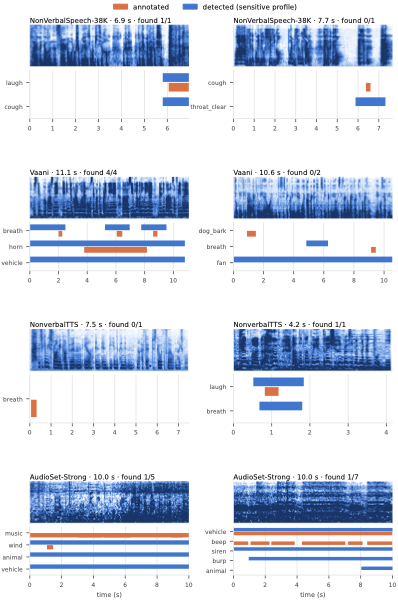
Rich Speech Event Detection Alignment Examples
Tap to enlarge

Audio Samples & Event Detections

Listen to sample audio clips and inspect the exact timestamped sound events, classification categories, and probability scores detected by Surround Sound (without ASR).

Speech Event Outputs 4 events detected
0.00s – 4.20s
animal
p=0.32
0.00s – 5.68s
music
p=0.93
0.00s – 5.68s
tv_speaker
p=0.63
2.64s – 4.12s
breath
p=0.65
Speech Event Outputs 2 events detected
0.00s – 5.76s
bird
p=0.94
0.76s – 2.88s
breath
p=0.76
Speech Event Outputs 2 events detected
0.00s – 2.16s
bird
p=0.95
0.00s – 2.16s
child_voice
p=0.73
Speech Event Outputs 2 events detected
0.00s – 2.32s
baby_cry
p=0.98
0.00s – 2.32s
child_voice
p=0.86
Speech Event Outputs 5 events detected
0.00s – 6.72s
fan
p=0.74
0.00s – 6.72s
music
p=0.72
1.04s – 1.76s
breath
p=0.71
3.16s – 3.72s
breath
p=0.71
4.84s – 5.56s
breath
p=0.76
Speech Event Outputs 6 events detected
0.00s – 4.68s
animal
p=0.56
0.00s – 9.96s
vehicle
p=0.91
0.00s – 9.96s
wind
p=0.90
2.00s – 9.96s
water
p=0.50
4.92s – 7.16s
breath
p=0.69
6.72s – 8.28s
animal
p=0.50
Speech Event Outputs 1 event detected
0.00s – 10.04s
music
p=1.00
Speech Event Outputs 2 events detected
0.00s – 5.08s
horn
p=0.93
0.00s – 5.08s
insect
p=0.92

Network Architecture (Figure 1 from Paper)

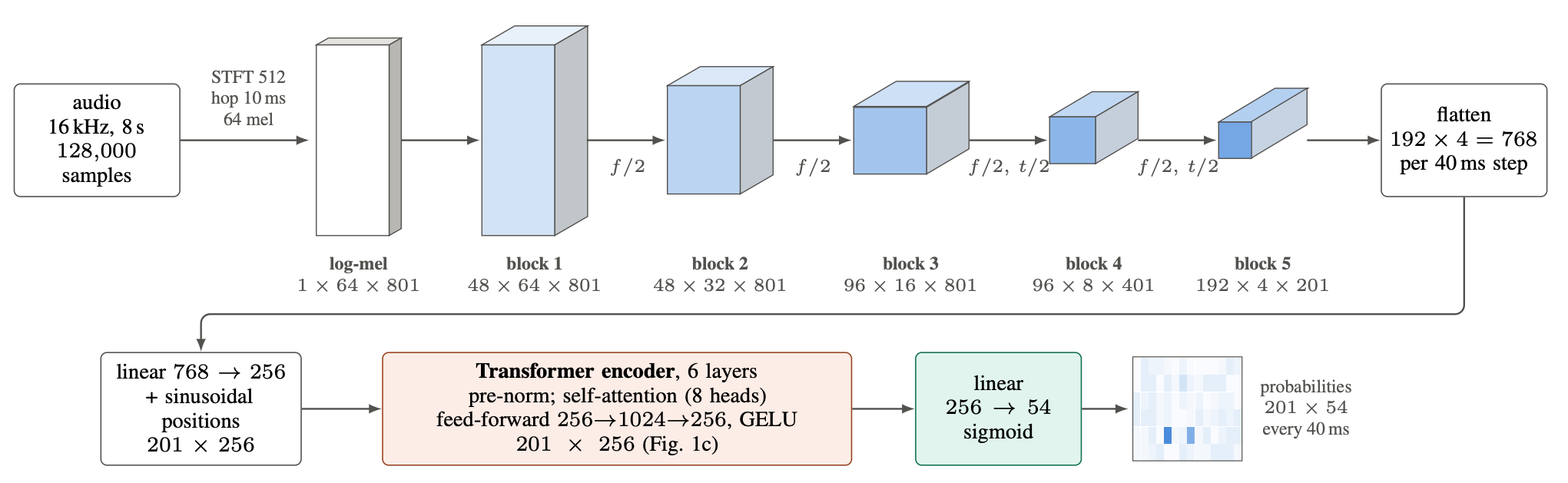
Architecture with tensor shapes measured with forward hooks on the released model. A 64-band log-mel spectrogram is downsampled by five convolutional blocks into 201 time steps (40 ms stride), contextualized by six Transformer encoder layers, and mapped to 54 independent class probabilities.

End-to-End Network Pipeline & Tensor Shapes

Figure 1 (Main)

Audio → Spectrogram: 8s waveform (128,000 samples at 16 kHz) converted via STFT 512 (10 ms hop) into a 64-band log-mel spectrogram (1 × 64 × 801).
5 Conv Blocks: Proportional 3D volumes shrink frequency (64 → 32 → 16 → 8 → 4) and time (801 → 801 → 801 → 401 → 201), producing 192 × 4 = 768 features per 40 ms step.
Transformer & Output: Linear projection to 256 dimensions with sinusoidal position encodings → six Transformer encoder layers (8 heads, d_ff=1024, GELU) → linear sigmoid layer outputting 201 × 54 class probabilities.

Speech Event Detector: End-to-End Network Architecture and Tensor Shapes
Tap to enlarge
1. Front-End Spectrogram
64 Log-Mel Bins • 801 Steps
STFT 512, 25 ms window, 10 ms hop, 50–8000 Hz, compressed as 10log10(x+1e-9) and scaled to [-1, 3].
2. Five Conv Blocks
866K Params (15% of model)
Channels: 48 → 48 → 96 → 96 → 192. Strides shrink frequency 64→4 and time 801→201. Each step draws on ~0.33s receptive field.
3. Transformer Encoder
6 Pre-Norm Layers (82%)
d_model=256, 8-head self-attention, d_ff=1024, GELU, dropout 0.1. Full 8s global acoustic context per frame.
4. Classification Head
54 Sigmoid Binary Heads (<1%)
Linear projection from 256 → 54 classes. Produces an independent frame-level probability track on a 40 ms grid.

(a) Training Pipeline, (b) Streaming Inference with ASR & (c) Inside the Blocks

Figure 1 (Modules)

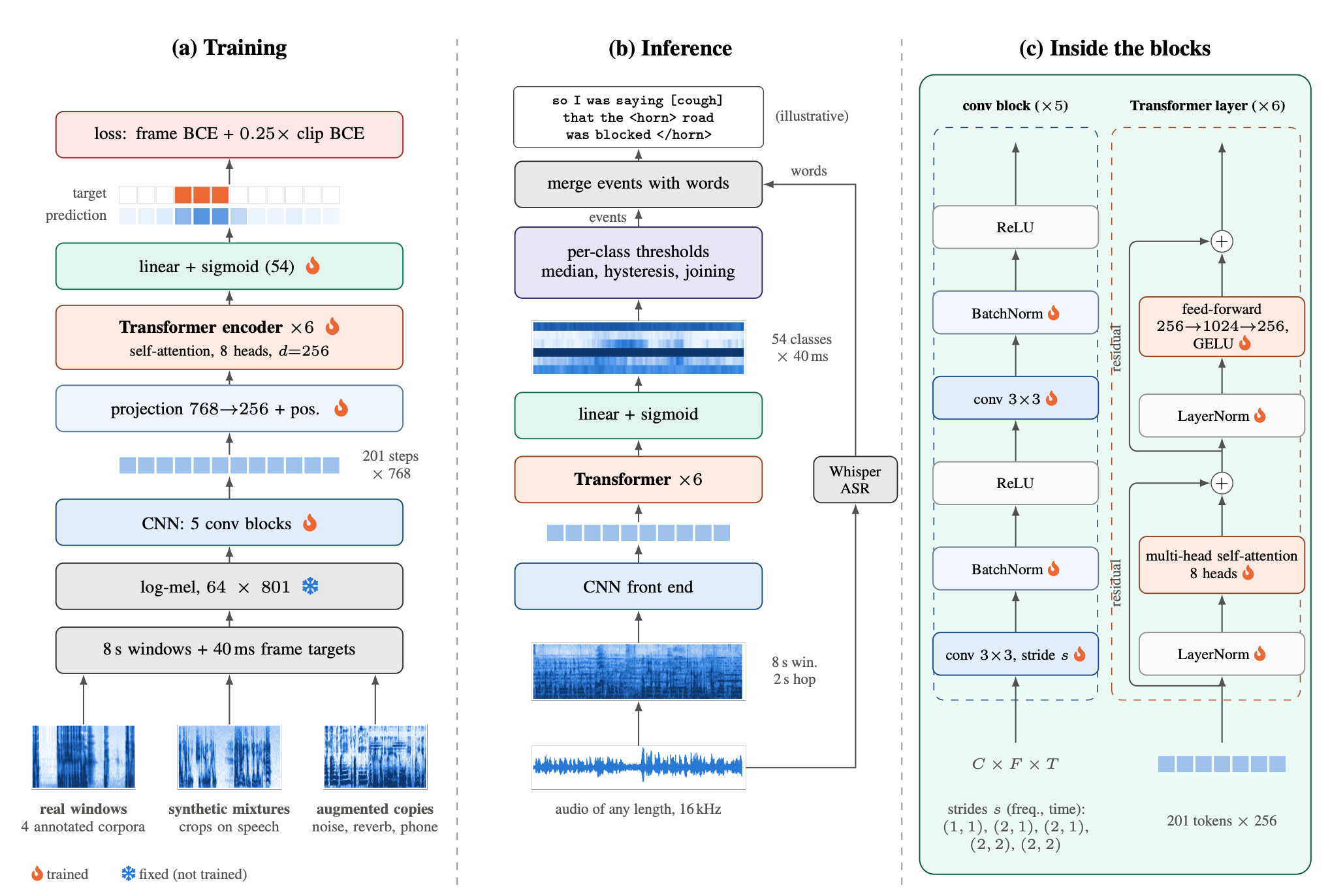
(a) Training: Multi-task loss combining frame-level BCE and clip-level BCE (0.25×) over real speech windows, synthetic mixtures, and acoustic augmentations (noise, reverb, telephony bandpass).
(b) Inference: Streaming audio of any length split into 8s windows (2s hop), passed through per-class hysteresis and median thresholding, and integrated with timestamped Whisper ASR tokens for rich transcription.
(c) Inside the Blocks: Detailed schematics of the 5 Conv blocks (2 × [conv 3×3, BatchNorm, ReLU] with residual shortcuts and frequency/time strides) and the 6 pre-norm Transformer encoder layers (LayerNorm, 8-head self-attention, LayerNorm, GELU feed-forward 256→1024→256).

Speech Event Detector: Training Pipeline, Inference Flow, and Block Schematics
Tap to enlarge

Layer-by-Layer Network Specifications (Table 2 from Paper)

Tensor shapes measured with forward hooks on the released model for one 8s window. Parameter counts are exact.

Layer Operation Output Tensor Shape Parameters
input waveform, 16 kHz, 8 s window 128,000 —
log-mel STFT 512 / win 400 / hop 160, 64 mel bands, log scale 64 × 801 —
conv block 1 2 × (conv 3×3, BN, ReLU); 1→48 ch; stride (f,t)=(1, 1) 48 × 64 × 801 21,456
conv block 2 2 × (conv 3×3, BN, ReLU); 48→48 ch; stride (f,t)=(2, 1) 48 × 32 × 801 41,760
conv block 3 2 × (conv 3×3, BN, ReLU); 48→96 ch; stride (f,t)=(2, 1) 96 × 16 × 801 124,992
conv block 4 2 × (conv 3×3, BN, ReLU); 96→96 ch; stride (f,t)=(2, 2) 96 × 8 × 401 166,464
conv block 5 2 × (conv 3×3, BN, ReLU); 96→192 ch; stride (f,t)=(2, 2) 192 × 4 × 201 498,816
reshape (C × F) per 40 ms step: 192 × 4 = 768 201 × 768 —
projection linear 768 → 256, + sinusoidal positions 201 × 256 196,864
encoder layers 1–6 6 pre-norm Transformer layers (8 heads, FF 1024, GELU) 201 × 256 4,738,560
head linear 256 → 54, sigmoid 201 × 54 13,878
Total Trainable Parameters (Conv: 853,488 • Proj: 196,864 • Transformer: 4,738,560 • Head: 13,878) 5,802,790

Layer Activation Maps & Signal Flow

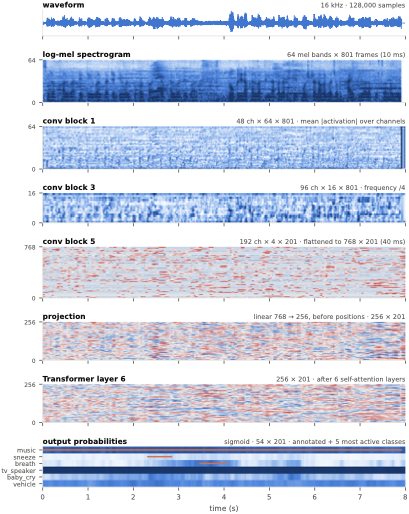
A held-out clip passing through the network: convolutional activations (mean absolute activation over channels), standardized 256-d vector activations across Transformer layers, and the final 54-class probability output tracks.

Signal flow through convolutional blocks and Transformer encoder
Tap to enlarge

Parameter Distribution by Component

Parameters by Layer

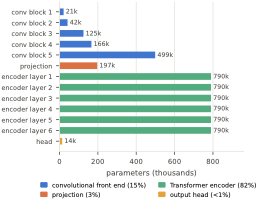
82% in 6 Transformer encoder layers (789,760 each), 15% in convolutional blocks, 3% in feature projection, <1% in output head.

Training Dynamics & Validation AP

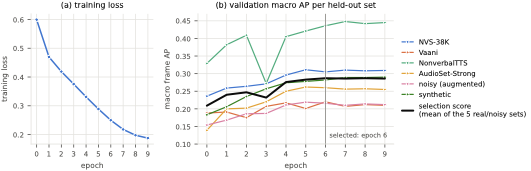
Training Log & Epoch Progression

Trained in ~3 hours on a single NVIDIA T4 GPU (~1,095s/epoch). Selected checkpoint from Epoch 6 achieved highest validation AP (0.287).

Explore All 54 Sound Classes

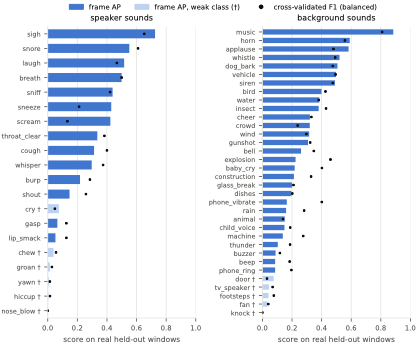
Surround Sound recognizes 20 speaker vocalizations and 34 background ambient noises. Filter by category, reliability, or search for any sound to view its cross-validated performance metrics.

Multi-Dataset Unification & CTC Forced Alignment

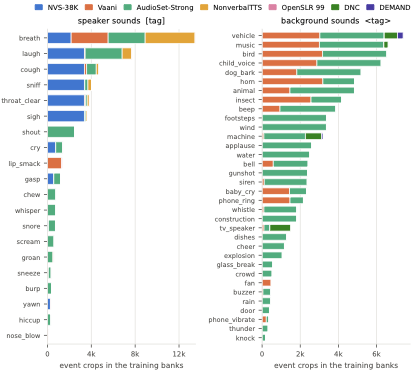
Trained on material drawn from seven public corpora whose labels arrived in incompatible formats: bounding boxes, free-text tags, transcript symbols, and environmental noise banks.

Dataset Source Size / Duration Label Format & Role Held-Out Evaluation Split License
NonVerbalSpeech-38K 38,718 clips • 130.6h Region-level non-verbal events; crops, beds, real windows 10% by stable clip hash (3,828 clips) CC BY-NC 4.0
Vaani Noise Events 90,637 clips • 154.6h 319 free-text noise tags with timestamps (58 Indian langs) 14 districts (verified clips only) CC BY 4.0
NonverbalTTS 6,256 clips • 17.6h 8,620 transcript-embedded tags → aligned via CTC Official dev + test (405 clips) CC BY-NC-SA 4.0
AudioSet-Strong 93,609 clips • 260h Strong ontology labels with millisecond start/end Official evaluation split Public Domain / Mirror
OpenSLR 99 727 clips • 410 spkrs Isolated phone-recorded vocalizations (trimmed crops) 15% of speakers CC BY-NC-ND 4.0
DNC Home Recordings 4,377 recordings Ambient noise crops (TV, music, appliances) 10% of sessions MIT
DEMAND 18 environments Multi-channel real ambient sound pool Last 20% of each recording CC BY 4.0

Recovering Timestamps via CTC Forced Alignment

Many valuable speech datasets (like NonverbalTTS) mark non-verbal sounds inside written transcripts (e.g., "I wanted to [laughter] tell you...") without giving timestamps. We used a Wav2Vec2 CTC forced aligner to locate the boundary of surrounding words, recovering exact timestamps for 6,360 out of 8,620 sounds.

Distribution of event crops across training sources

Held-Out Evaluation & Operating Profiles

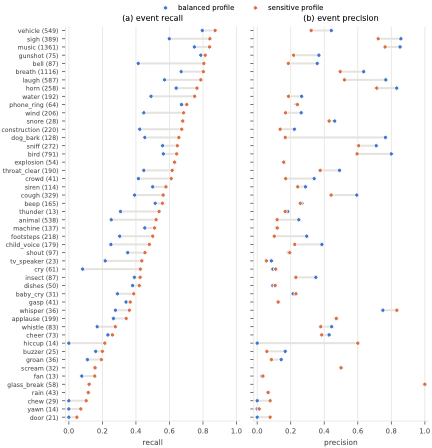
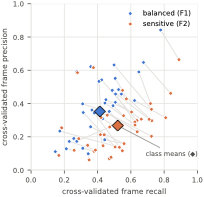
Evaluated at the event level on held-out recordings across four datasets. Surround Sound provides two operating threshold profiles: Sensitive (S) tuned for F2 (prioritizing recall for human review) and Balanced (B) tuned for F1.

Classes Count Held-Out Events Macro Recall Macro Precision Macro F1 Micro Recall (Event-Weighted)
Sensitive Balanced Sensitive Balanced Sensitive Balanced Sensitive Balanced
Speaker Sounds 16 3,271 0.455 0.327 0.383 0.395 0.378 0.338 70.3% 54.2%
Background Sounds 32 6,096 0.510 0.390 0.261 0.345 0.294 0.325 65.6% 52.8%
All Evaluated Classes 48 9,367 0.491 0.369 0.302 0.361 0.322 0.329 67.2% 53.3%

Event Evaluation by Dataset

Event Evaluation Across Datasets

Threshold Profile Tuning (F1 vs F2)

Profile Threshold Comparison

Per-Class Average Precision (AP)

Per-Class AP

Get Started in 3 Lines of Code

Surround Sound works out of the box with PyTorch and any Whisper backend (OpenAI Whisper or Hugging Face Transformers).

from sed import Detector, load_audio, rich_transcript, clean # Load model weights & threshold profile directly from Hugging Face Hub det = Detector.from_pretrained("theboringai-work/surround-sound", profile="sensitive") # 1. Detect timestamped events in any audio file (ffmpeg supported) events = det.detect("call.mp3") print("Detected Events:", events) # [{'label': 'cough', 'start': 0.68, 'end': 2.0, 'prob': 0.92}, ...] # 2. Extract raw 40 ms probability tracks times, probs = det.frame_probs(load_audio("call.mp3")) # 3. Seamlessly merge with word timestamps from any Whisper ASR # words = [(word, start_sec, end_sec), ...] text = rich_transcript(words, clean(words, events)) print("Rich Transcript:", text) # 'Hey [cough] there, can you tell me where I am going? <horn> the road was blocked </horn> okay.'

BibTeX

BibTeX Citation
@article{bar2026speecheventdetector,
  title   = {Speech Event Detector: Timestamped Detection of Non-Verbal Vocalizations and Background Sounds for Rich Speech Transcription},
  author  = {Bar, Ayush Kumar and Ghosh, Promila},
  journal = {arXiv preprint arXiv:2610.14232},
  year    = {2026},
  url     = {https://arxiv.org/abs/2610.14232}
}